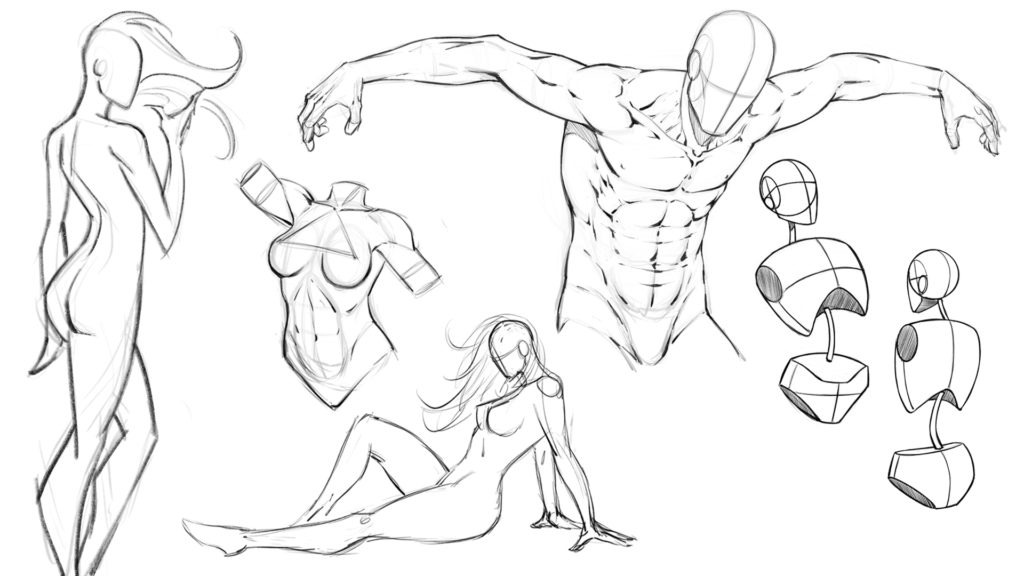
On this page you will find various drawing tutorials for comic artists. You can click on the images to enlarge and draw along. Share your work and this page if you find these lessons to be helpful!
Let me know what other art tutorials you would like to see covered on this site and I will make sure to add them as soon as I can!
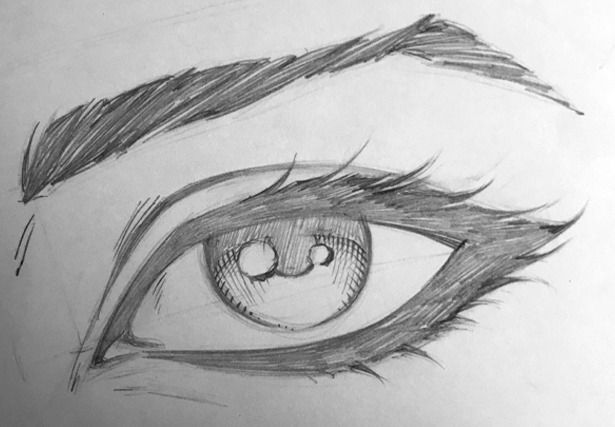
In this tutorial you will learn how to draw a comic style eye step by step. Be sure to practice this often but also to experiment with each stage of this process. You will find your style by experimenting with variations of shapes and rendering so just have fun with it!
In this drawing exercise I will be using a 2H lead on Bristol board smooth paper but you can follow along with whatever art supplies you prefer. Remember to start loose and get some sketches going to warm yourself up.
Step 1 – Drawing the Basic Shape of the Eye
Drawing Comic Art Style Eye Tutorial
For this first step I like to focus on the overall shape of the eye as well as the angle from the tear duct to the opposite side where the eye lids meet. I tend to notice an upward tilt and by establishing that early on, it becomes easier to consistently draw them.
This is an excellent time to play with various differences in the shape of the eye. Practice making the shapes more narrow, more rounded, more pointed to one side, and so on. You can create all sort of fun variations for your comic book character types!
Step 2 – Drawing the Iris and the Pupil
For the second step, draw in the iris and the pupil. A good rule of thumb is that the iris is about one third the distance across of the eye. To be honest I experiment with this proportion as well. Sometimes to really push the expression of fear or excitement I will purposely make the iris smaller by comparison. It’s comics so we can get away with it I promise.
Also notice that the iris is touching the top eye lid. This gives a more relaxed look to the eye. Subtle differences in the position of the iris and pupil can change the expression of the character so keep an eye on it!
Step 3 – Drawing the Shape of the Eyelid
In this third step, draw the shape of the eyelid. This can pretty much follow the existing edges but I like to taper it a bit taller as it moves around the rounded or middle part of the eye. We have to try to envision the spherical form of the eye ball beneath the skin. Again, play around with this area within your work to find what suits your style the best.
Step 4 – Drawing the Shape of the Eye Lashes
In this fourth step, I like to draw the eye lashes as large basic shapes. This helps me to simplify the process a bit and it makes a lot of sense for comics especially when you are drawing your smaller faces within a scene. Individual eye lashes are great for close ups but that’s about it. Besides you can always add those in as you will see shortly.
I think it goes without saying but this is another on of those times where you can really experiment with a variety of shapes. I will be honest and tell you I didn’t like the look of this stage of the work but I knew I could save it so I pressed forward. Some times you just have to keep fiddling with it and not give up!
Step 5 – Drawing in the Shape of the Eyebrow
In this fifth step, draw in the shape of the eyebrow with some basic angles in mind. I like to imagine the plane changes of the characters forehead when doing this. I also feel that by keeping this step as simple as possible I can lay in the ground work for the details later. If I start by trying to draw in a bunch of little hairs I tend to end up with a mess. No one likes messy eyebrows!
Step 6 – Drawing the Glare and Shadow
Step 6 – Drawing the Glare and Shadow to the Eye
In this step we will draw the glare and the shadow on the iris. Draw the shadow over the iris as a curve. This helps to push the look that the eye is a sphere and not a flat object. Then draw in the glare on the highest point of the eye, usually right by the pupil. This is another chance to play around with style choices but then again, you already knew that didn’t you?
Step 7 – Draw in the Shadows and Add Some Eye Lashes
Step 7 – Draw in the Shadows and the Eye Lashes
In this step we can fill in the shadows and add some eye lashes. I tend to change the shape of the eye lashes as I do this. Sometimes I will erase back the perimeter shape so that I can try different effects with the eye lashes. I like paying attention to other comic artists and how they define this area of their work. One of my favorites to study for eyes is the late Michael Turner (RIP). His work is breath taking and the way he rendered eyes was nothing short of AMAZING!
Step 8 – The Final Rendering
In this final step, soft eraser all those rough lines and clean it up. I like to push and pull the lines here. Some need a little more curve and some need a little less. I also like to add in a bit of cross hatching to the eyes to create a look of tonal value. And, that’s it. You can take these same steps and apply them to all sorts of eye variations.
I hope you found this drawing tutorial to be helpful and if you did please share the content with your fellow artists. More on the way soon and good luck with your art!
How to Draw Comic Style Art – From Sketch to Rendering
If you want to learn more on Drawing Comic Style Art, I have a full course on the subject here called, “How to Draw Comics Style Art – From Sketch to Rendering. “
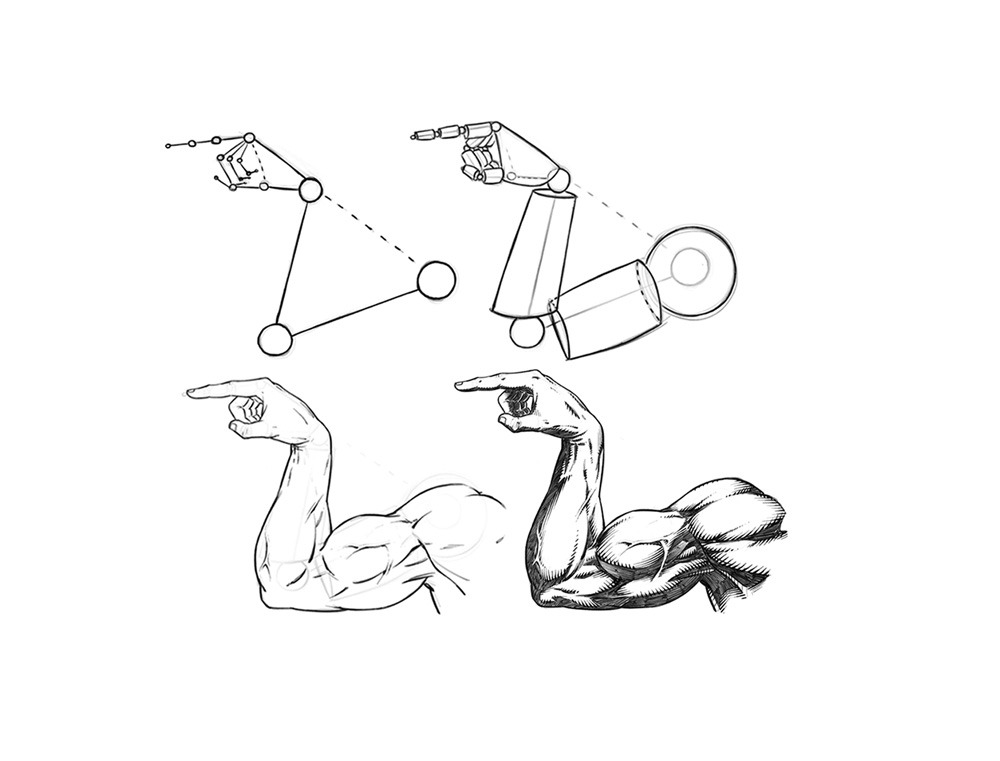
In this tutorial we will be drawing a male muscular arm. This time it’s the old, “Which Way to the Beach” pose. We have all done it one time or another, right? Let’s get to it!
Step 1 – Draw out the direction of the pose with the line and circle method. Think of these like the bones under the muscles and at this stage just focus on the length and direction of each section of the arm and hand. Notice the relationship from the wrist to the shoulder and the shape of the base of the hand from this angle.
They are both triangular. It helps to notice shapes like these to make your drawings more consistent.
Drawing an Arm Pose – Step 1 – Arm Structure
Step 2 – Now draw out the cylinder shapes to establish the basic forms. Think of a mannequin or marionette. Keep it simple and still only think about proportions and direction of the segments. Also be open to changes at any stage of this process. Correcting things early on will save you lots of time and heartache.
Drawing an Arm Pose – Step 2 – Basic Forms
Step 3 – Now soft erase your lines and start to draw more curvature for your anatomy. Notice the way that each area tapers inward to meet the next. The shoulder tapers in to meet the upper arm and the upper arm tapers in the meet the lower arm and so forth. And notice where I changed the shape of the anatomy to go inside and outside of the initial mannequin stage. The basic construction is only meant to be a guide, so I never hesitate to make changes if I see something that could be better.
Drawing an Arm Pose – Step 3 – Anatomy
Quick Tip – Study anatomy often but improve over a long period of time. Don’t let the idea of perfection slow you or stop you from completing your work!
Step 4 – Now like before, soft erase your lines and begin to refine the anatomy a bit more. This time giving more line weight and clarity to the drawing. You can also start to draw in some veins to add to the depth and realism to the drawing.
Drawing an Arm Pose – Step 4 – Refining the Line Work
Step 5 – Draw in the shapes of shadows to your muscles. And if you are working with an inker make sure to sketch the small x’s so they can read the artwork more clearly. You don’t necessary have to do this step if you are your own inker but it doesn’t hurt to get in the habit, just in case!
Drawing an Arm Pose – Step 5 – Adding in the Shapes of Shadows
Step 6 – Now add in your rendering lines and really start to make the artwork pop off the page. Notice how the veins cast a small shadow of their own on one side. And, how they catch light on them even in the shadow of the arm. This is more stylized but it gives the appearance of depth. Overall this is a very stylized arm drawing but that is the fun of comics, not everything has to be entirely accurate!
Drawing an Arm Pose – Step 6 – Rendering and Cross Hatching
I hope you’ve enjoy this quick tutorial on stylized arm anatomy for comics. This is a sample tutorial from my book “Learn to Draw Action Heroes” which you can find on Amazonor at Barnes and Nobel.
Thank you for stopping by and more tutorials are on the way soon.
Keep drawing keep having fun! 🙂
-Robert
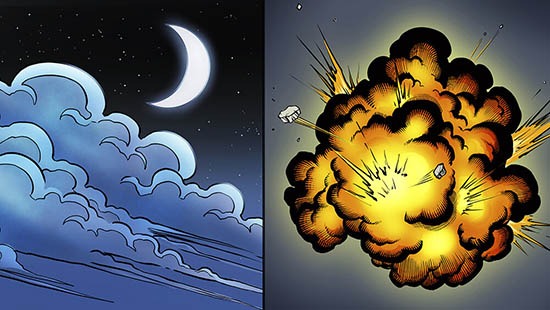
In my latest Youtube video I explain how to draw some of the basic dynamics for smoke, clouds, and explosions. These effects are widely used for comics and other forms of storytelling.
Drawing Smoke Clouds and Explosions for Comics
Check out the video below to see these two effects created!
Hopefully this post + video will help you get a bit better at drawing these elements within your own work. Remember if you don’t get it right the first time there is nothing to worry about. I didn’t either! Let’s jump in and start practicing.
Drawing Smoke
Let’s first start by drawing some basic smoke coming off a smoke stack. This is used in countless scenes in comics and is pretty much my favorite one to draw.
You can have this effect swirling in the background and make any city scene immediately look 10 times cooler. ( In my opinion of course! 😉
Step 1 – Start by drawing the area of influence or the basic flow of the smoke. Don’t be afraid to swirl it around a bit. I like to think about ribbons and scrolls when drawing smoke.
Drawing Smoke – Step 1
Step 2 – Erase back your construction lines or turn the opacity down on your layer. Then draw the smoke again with a bit more clarity. I like to go back and forth from thick to thin forms as the smoke rolls around. This way it looks more organic and dynamic. Use S and C curves for energy.
Drawing Smoke – Step 2
Step 3 – Draw in some of the interior lines. These can swirl around any which way you want. I like to start envisioning how the smoke might look with color at this stage. It helps me to think more dimensionally about the work as I go. You can also add in some line weight at this stage as well.
Drawing Smoke – Step 3
Next just ink and color it and voila! Comic book smoke! Just play with lots of variations and see what you can come up with. There is no right or wrong way with comic book smoke and art in general for that matter. If you’re having fun then your on the right track! 🙂
Watch my this Youtube video on the subject and get more tips and tricks on creating more effects.
I hope you enjoy the tutorials and more on the way soon!
Let me know what other topics you would like to see covered on this blog and I will do my best to answer them with a new tutorial. I love doing break downs like this and your ideas help me to focus on what to do next.